
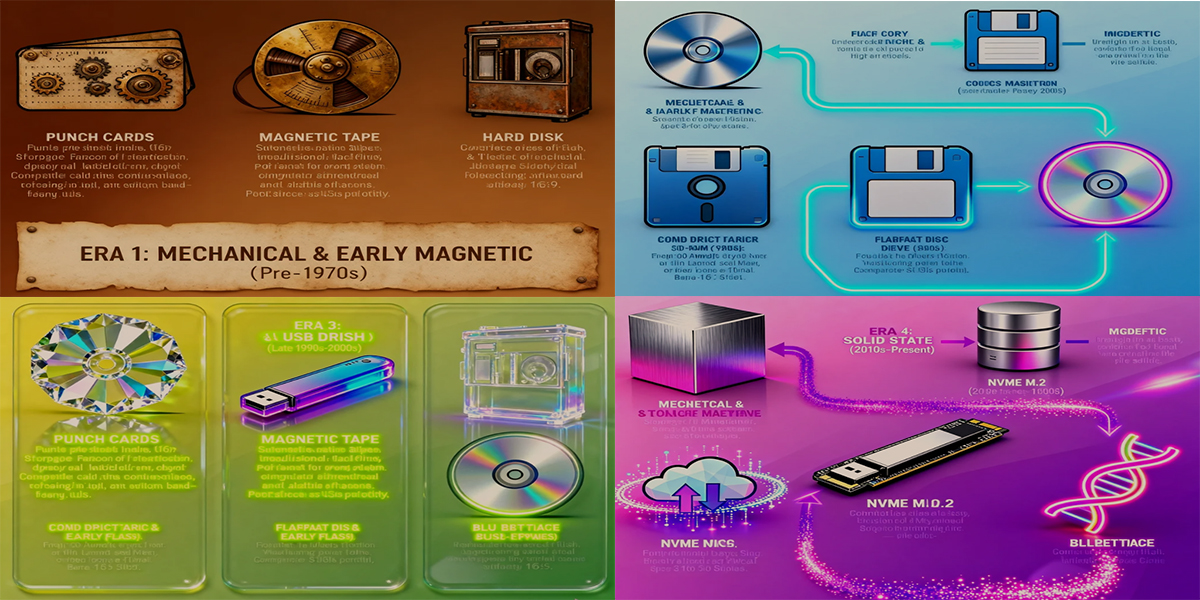
It is often argued that “the majority of technological products have an inherently short lifecycle in the market.” Today, I aim to delve into the evolutionary trajectory of storage devices amid the technological era.
The Past: Pioneers of Storage Era – Early Exploration From Floppy Disks to HDD
Following the evolution of storage media—from knotted cords and oracle bones to stone tablets and paper—the advent of the Industrial Revolution catalyzed a paradigm shift in storage device technology. Below is an overview of mechanical storage systems that emerged during the Industrial Age.

Punched cards and punched paper tapes: the original storage mediums for mechanized information.
In 1890, Herman Hollerith, an American statistician, developed the punch-card tabulating machine—an innovative device capable of storing up to 960 bits of data—specifically designed for the collection and tabulation of census information. This landmark invention ushered in the era of semi-automatic data processing systems, which subsequently gained widespread adoption across industrial indexing and data statistical analysis domains.

Punched cards and punched paper tapes served as input and output (I/O) devices for early computers, particularly in conjunction with punch-card tabulating machines. These media encode programs and data into binary code—a representation wherein punched holes denote the digit “1” and non-punched areas correspond to “0”—which is then fed into the computer via photoelectric scanning technology.
Magnetic tape: the genesis of the magnetic storage era.
In 1928, Fritz Pfleumer, an engineer hailing from Dresden, Germany, developed the audiotape—a medium capable of storing analog signals. The operational principle of magnetic tape involves coating a paper strip with pulverized magnetic particles to form the recording medium. However, the inherent fragility of the paper substrate rendered early audiotapes impractical for widespread use. It was not until 1951 that magnetic tape was adapted for computer data storage, with a single tape offering the equivalent storage capacity of 10,000 punched paper tapes. By 1980, compact cassette tapes emerged; a 90-minute cassette could store approximately 660 kilobytes (KB) of data per side. To this day, advanced tape storage technologies such as LTO (Linear Tape-Open) remain indispensable in enterprise IT infrastructures, serving as a cost-effective, high-capacity solution for long-term data archiving and disaster recovery.

Drum memory: the technical predecessor to hard disk drives.
In 1932, Gustav Tauschek—an Austrian engineer affiliated with IBM—developed the drum memory, a 16-inch-long magnetic storage device featuring 40 tracks, a rotational speed of 12,500 revolutions per minute (RPM), and a storage capacity of merely 10 kilobytes (KB). Prior to the advent of magnetic core memory, drum memory was extensively deployed as main memory in early computing systems and is widely recognized as the technical predecessor to hard disk drives (HDDs). Key advantages of drum memory included its practicality, reliability, and cost-effectiveness, while its primary limitations were its constrained storage capacity and low utilization efficiency.

Magnetic core memory: an early implementation of random access memory (RAM).
In 1949, Dr. An Wang, affiliated with the Harvard University Laboratory in the United States, pioneered the read-write technology for magnetic core memory. The operational principle of this memory technology lies in the magnetic core’s ability to undergo magnetization in two opposing directions based on the current polarity during the magnetization process, with these two states corresponding to the binary digits “0” and “1” for data storage. Early magnetic core memory modules featured a storage capacity of merely several hundred bytes. Widely adopted as the primary main memory solution for computing systems throughout the 1970s, magnetic core memory remained prevalent until the mass production of Intel’s semiconductor-based DRAM (Dynamic Random Access Memory) emerged as its successor.

Hard Disk Drive (HDD): the hallmark of the disk storage era.
In 1956, Reynold B. Johnson of IBM led a research and development (R&D) team in developing the world’s first hard disk drive (HDD)—the IBM 305 RAMAC. Measuring approximately the dimensions of two refrigerators and weighing one ton, this pioneering storage system incorporated 50 platters (each 24 inches in diameter) with a total storage capacity of a mere 5 megabytes (MB) and a data transfer rate of 10 kilobytes per second (KB/s). Today, desktop HDDs typically feature a 3.5-inch form factor, and products boasting a capacity of 24 terabytes (TB) or higher have been commercialized—exemplifying the continuous advancement of magnetic storage density.

Floppy Disk: The earliest removable storage medium for personal computers (PCs).
First introduced by IBM in 1971, floppy disks gained widespread adoption from the mid-1970s through the late 1990s. Initially launched as 8-inch media, they later evolved into 5.25-inch and 3.5-inch form factors. The original read-only floppy disk, released in 1971, featured a storage capacity of 79.9 kilobytes (KB), with a read-write variant emerging one year later. Despite their relatively slow access speeds and limited storage capacity, floppy disks offered the key advantages of removability and portability.

CD-ROM: An optical information storage medium.
In 1982, Sony and Philips jointly launched the CDP-101—the world’s first commercial compact disc (CD) audio player—propelling the widespread adoption of CD technology. Initially deployed exclusively in the film industry, early CDs featured a 30-centimeter diameter, with each side capable of storing up to 60 minutes of video or audio content. Today, the storage density of CD-based optical storage technology has undergone continuous advancement, spawning derivatives such as CD-ROM, DVD, D9, D18, and Blu-ray Disc (BD) technology. Even now, optical discs remain in use for applications including game console game discs, retail movie releases, and long-term data archiving materials.

The Present: Storage Mainstays Powering Digital Life – Core Devices We Use Daily
With the advancement of computing technology and the gradual advent of the Internet era, the demand for information storage among users has continued to surge—driving the accelerated evolution of storage devices. Below is an overview of the storage solutions commonly deployed in contemporary computing environments.
Solid State Drive (SSD): Simplifying Computer Systems
The first solid-state drive (SSD)—a storage device constructed from an array of solid-state electronic memory chips—emerged in 1989. Subsequently, SSDs underwent gradual commercialization and were adopted across specialized sectors including medical, aerospace, and military applications. Compared to traditional hard disk drives (HDDs), SSDs offer distinct advantages: high read/write speeds, shock and drop resistance, low power consumption, silent operation, and a compact, lightweight form factor. Today, the industry-wide transition to NVMe (Non-Volatile Memory Express) over the PCIe (Peripheral Component Interconnect Express) bus has delivered a dramatic performance leap, surpassing the inherent limitations of legacy SATA interfaces. While SSDs still have a finite lifespan constrained by program/erase (P/E) cycle limits, technologies such as TLC (Triple-Level Cell) and QLC (Quad-Level Cell) continue to enhance cost-efficiency and endurance.

SD Card (Secure Digital Card): A Memory Card Based on Semiconductor Flash Technology
In 1999, Panasonic, Toshiba, and SanDisk Corporation (Japan-based and U.S.-based collaborators) jointly developed the Secure Digital (SD) Card. Initially available in capacities of 2, 4, and 8 megabytes (MB), the SD Card has undergone successive standard revisions, with current offerings reaching 128 gigabytes (GB), 512 GB, and even 1 terabyte (TB). During the era when mobile phones were primarily used for communication and MP4 players were prevalent, SD cards emerged as the dominant medium for mobile data storage. They enabled mobile phones to store additional music files (serving as makeshift music players) and allowed MP4 devices to hold more movies (functioning as portable video players). Modern standards such as SD Express are introducing higher-speed data transfer capabilities by leveraging the NVMe interface, rendering SD cards suitable for high-demand applications like professional 4K and 8K video recording.

USB Flash Drive: A Storage Device Utilizing Flash Memory Chips as the Storage Medium
The USB flash drive was first introduced in 1998. In 2004, Netac Technology Co., Ltd. (China) was granted a fundamental invention patent for flash drive technology by the United States Patent and Trademark Office (USPTO). Characterized by its compact form factor and high storage capacity, the USB flash drive enables users to transfer and carry computer files on-demand via simple plug-and-play functionality. Contemporary standards such as USB 3.2 and USB4/Thunderbolt 4 deliver exceptional data transfer speeds, with typical capacities now reaching 2 terabytes (TB), solidifying its position as a versatile storage tool. Specialized variants—including bootable USB flash drives, anti-virus USB flash drives, temperature-monitoring USB flash drives, and music-specific USB flash drives—continue to be developed and refined.

The Future: Game-Changing Storage Tech – Emerging Innovations That Will Rewrite the Rules
Driven by the rapid advancement of cloud computing, big data, the Internet of Things (IoT), and artificial intelligence (AI), humanity has entered an era defined by an “information explosion.” As the volume of data undergoes exponential growth, storage technologies are evolving at an accelerated pace. With continuous technological innovation, storage devices—acting as the core carriers of information—are poised for even faster development. Below is a discussion on the future of storage technologies.
Nanostorage: A Prominent Direction for Future Storage Development
In 1998, researchers from the University of Minnesota and Princeton University (U.S.) successfully developed the quantum disk—a nanoarray system composed of magnetic nanorods. This pioneering storage device offered a storage capacity equivalent to 100,000 to 1 million conventional hard disk drives (HDDs) of its era, while reducing energy consumption by a factor of 10,000.
In 2002, a research team from the University of Wisconsin-Madison (U.S.) developed an atomic-scale silicon memory material, boasting an information storage density one million times higher than that of contemporary optical discs.
In 2014, Professor Sharon Grotz from the University of Michigan published findings demonstrating that nanoparticle assemblies behave like Rubik’s Cubes—twisting around a central axis—with their state transitions enabling binary encoding (representing “0s” and “1s”) for data storage.
Nanostorage technologies leverage diverse methodologies to fundamentally enhance storage capacity, replacing existing storage media with ultra-high-density devices and materials. As such, it stands as a pivotal development direction for the future of data storage systems.
DNA Data Storage: The Pinnacle of Storage Density
Beyond nanostorage, DNA data storage stands out as a prominent and promising research frontier. This innovative technology entails encoding digital binary data (represented as “0s” and “1s”) into the four canonical nucleobases of synthetic DNA: Adenine (A), Cytosine (C), Guanine (G), and Thymine (T). It delivers unparalleled storage density—with the potential to house the entirety of the world’s data in just a few kilograms of DNA. Additionally, DNA exhibits exceptional durability, boasting a theoretical archival lifespan of hundreds of thousands of years—far exceeding that of modern magnetic or optical storage media.
Cloud Storage: A Continuously Evolving Storage Technology
To conclude, a brief overview of cloud storage is provided. In essence, cloud storage involves aggregating storage resources across a distributed infrastructure comprising numerous storage devices and servers. Users can connect to the “cloud” via any network-enabled device, enabling convenient, on-demand data access from anywhere at any time.

Cloud storage supports two primary implementation models:
1. Public Cloud
Public cloud storage is delivered as a third-party hosted service, with data stored in remote data centers. Users have no direct control over the underlying cloud infrastructure and typically lack visibility into the technologies employed. Common examples include consumer-facing cloud storage services (e.g., cloud disks) widely used in daily life.
2. Private Cloud
Private cloud storage is deployed and operated internally within an enterprise’s data center, providing dedicated cloud services such as storage capacity provisioning and rapid deployment of enterprise application systems.
Cloud storage enhances storage efficiency and space utilization, enabling users to perform remote data backup and transmission on-demand while reducing disaster recovery (DR) and backup costs for organizations. However, it also faces inherent challenges, including data sovereignty and compliance requirements, security risks (e.g., data breaches, unauthorized access, and leakage of personal privacy or commercial data), and the evolving Total Cost of Ownership (TCO) model. Amid the era of the Internet of Everything (IoE) and the pervasive wave of big data, cloud storage technology is poised for continuous advancement.